

Get TestNet Tokens
To build and test, your account needs two things on TestNet: a balance of PAS (the Paseo TestNet token, which pays transaction fees) and per-service allowances for the infrastructure your Product uses.
Prerequisites
Section titled “Prerequisites”Before getting started, ensure you have:
- Completed the Install Polkadot Desktop and Pair guide so Polkadot Desktop is paired with your signer
Get Tokens
Section titled “Get Tokens”The Polkadot Faucet distributes free PAS tokens to developers.
-
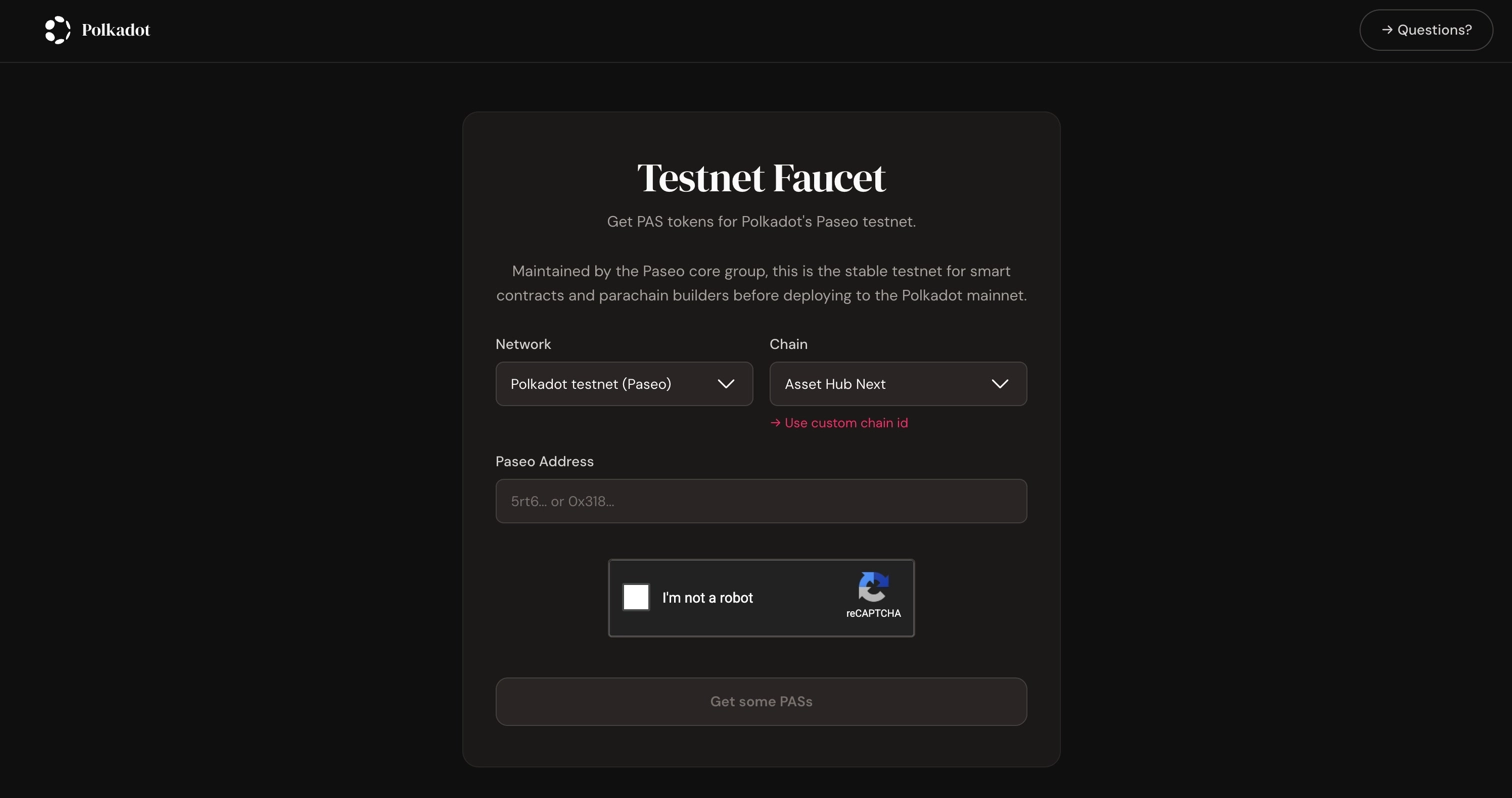
Open the Polkadot Faucet for parachain 1500. Paseo Next v2's Polkadot Hub is parachain 1500, so use this link rather than picking a network by hand.
-
Paste the address of the account paired with Polkadot Desktop into the address field.
-
Click Get Some PASs to request tokens. They arrive in your account shortly after the request is processed.
Service Allowances
Section titled “Service Allowances”Some Polkadot infrastructure services use a separate allowance-based access model. These allowances are independent of your token balance; even with enough PAS to cover fees, a missing allowance will cause the service to reject your request. Allowances are granted per account, so a missing or misdirected one surfaces as no allowance set for account or rejected uploads; see Accounts and Signing for granting them to the account that actually signs.
Service Allowances: Bulletin Chain Storage
The Bulletin Chain has no token balance for storage. Every account needs an explicit authorization that grants a quota of transactions and bytes before it can store data on-chain. Without authorization, storage extrinsics are rejected.
On TestNet, request your storage authorization directly from the Bulletin Chain authorization page. This is required before submitting any store extrinsic from your Product.
After your authorization request is confirmed, you can verify the allocation on-chain by querying the Authorizations storage map of the transaction-storage pallet for your account.
Service Allowances: Statement Store
The Statement Store lets accounts publish off-chain statements that are gossiped and persisted by the network. Access is controlled by an on-chain StatementAllowance record that specifies two limits per account: max_count (the maximum number of statements the account can publish) and max_size (the maximum total bytes across those statements).
Service Allowances: dotNS Names
dotNS name registration charges the same refundable deposit for every name it admits on the public path, whatever its length. The deposit is paid in the network's native token, so on Paseo it is PAS, and names carry the environment's TLD rather than .dot. The public path sells only names of nine characters or more. Device and personhood names of six to eight characters are earned through the personhood gateway instead, and carry no deposit.
See the dotNS PopRules and Pricing reference for the bands and the deposit.
Where to Go Next
Section titled “Where to Go Next”-
Build Your Product
Set up a local project, load it in Polkadot Desktop via the
localhostbypass, and add capabilities guide by guide.